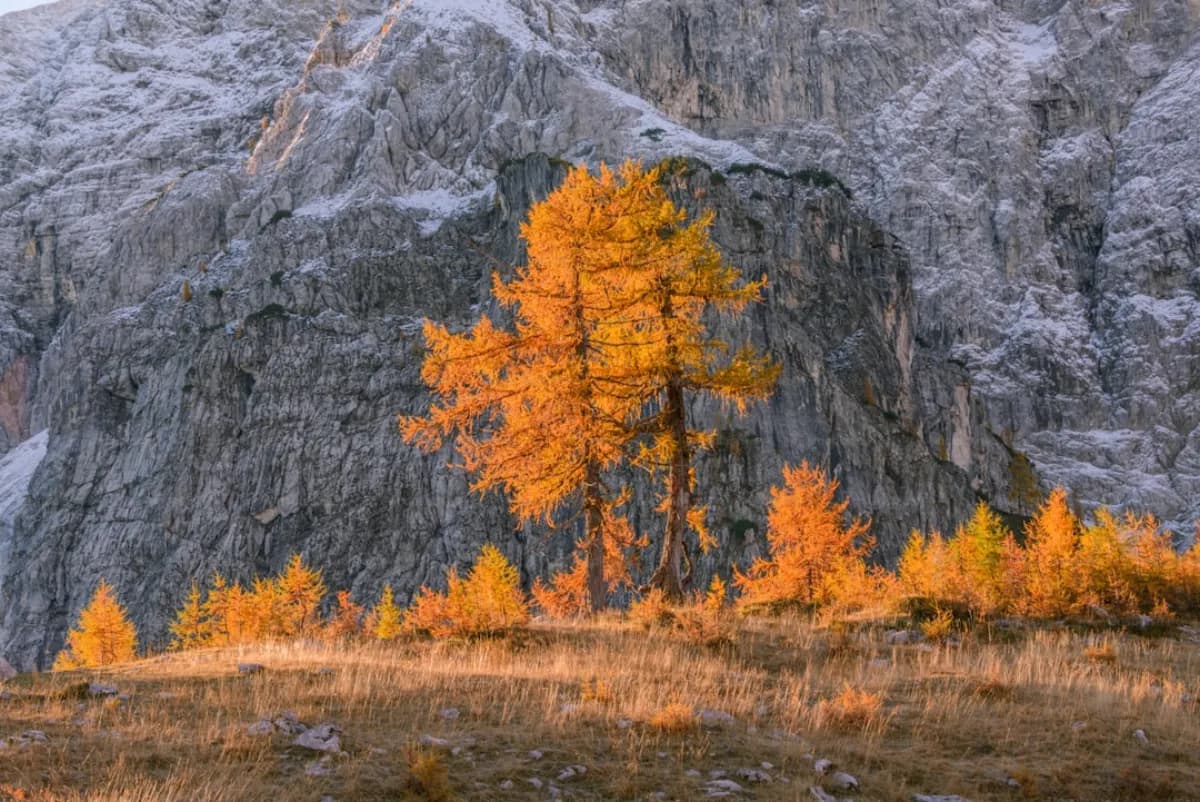
There is a season in the Dolomites that few tourists truly know about, yet it is the one many locals consider the most beautiful: autumn. When the summer crowds leave and the first crisp air paints the forests in gold, copper and fiery red, these mountains put on a show that takes your breath away. The Dolomites foliage rivals anything New England can offer — and with towers of pale rock as a backdrop, it arguably surpasses it.
In this guide we take you through everything you need to know about autumn in the Dolomites: when to come, what to see, what to eat and how to experience adventure in a frame of impossible colours.
The Larch Foliage: Gold on the Mountains
Why Larches Are Special
Larches (Larix decidua) are the only European conifers that shed their needles in autumn. This makes them the absolute stars of the Dolomites foliage season. Starting in mid-October, their needles shift from bright green to golden yellow, then to deep orange, creating a stunning contrast with the dark green spruce and the pale grey rock walls.
Larches cover roughly 25% of the Dolomite forests between 1,500 and 2,200 metres. Val di Funes, Val Badia and the area around San Vigilio di Marebbe offer some of the most spectacular concentrations, with entire hillsides transforming into golden carpets.
The Best Weeks for Foliage
The peak of foliage depends on altitude and temperatures:
| Period | Altitude | What to Expect | |--------|----------|----------------| | Late September | Above 2,000 m | First golden larches at high altitude | | First week of October | 1,800-2,200 m | Intense colours on alpine pastures | | Mid-October | 1,200-1,800 m | Peak foliage — the perfect week | | Late October | Below 1,200 m | Valley floor colours, last golden larches |
The second and third weeks of October are statistically the best for foliage around San Vigilio di Marebbe (1,200 m). Book your accommodation and activities well in advance — it is the Dolomites' best-kept secret, but more people discover it every year.
Autumn Enrosadira: Magic at Sunset
If the Enrosadira is always spectacular, in autumn it reaches another level. The clearer, drier air amplifies the colours of the Dolomites sunset, and the combination with the golden larch foliage creates a double chromatic spectacle that photographers from around the world chase.
In autumn the sun sets earlier — around 6:00-6:30 PM in October — which means you don't have to wait until late evening to enjoy the show. The best viewpoints remain the Passo delle Erbe and Plan de Corones, where the autumn panorama adds an extra dimension.
Torggelen: The Taste of Tradition
What Is Torggelen
Torggelen (pronounced "tergghelen") is a South Tyrolean tradition dating back to the Middle Ages. After the grape harvest, farmers would open their cellars and offer the new wine alongside roasted chestnuts, speck, cheeses and traditional dishes. Today this custom has evolved into a full autumn ritual celebrated in farmsteads, mountain huts and restaurants throughout the region.
What You Eat and Drink
- Roasted chestnuts — gathered from forests below 1,000 m
- New wine (Nuier or Suser) — the first must of the harvest
- Schlutzkrapfen — Tyrolean ravioli filled with spinach and ricotta
- Smoked speck — South Tyrol's signature cured meat
- Sweet Krapfen — doughnuts filled with jam or poppy seeds
For more on local cuisine, read our guide to South Tyrol speck and the South Tyrol wine guide.
Mushroom Picking: The Forest's Hidden Treasure
Autumn is mushroom season in the Dolomites. The larch and spruce forests are rich with porcini (Boletus edulis), chanterelles (Cantharellus cibarius) and honey fungus. Mushroom picking is regulated in South Tyrol: you need a daily permit and the limit is 1 kg per person per day.
Where to look: Mixed forests of broadleaf and conifer trees between 1,000 and 1,500 m are the most productive. The woods around San Vigilio and Val Badia are particularly rich after the late September rains.
Important tip: If you are not an expert, join a guided foraging walk or take your harvest to the local pharmacy for free identification checks.
Zipline Over Autumn Colours
Imagine flying at 80 km/h over a carpet of golden larches, with the Dolomites glowing from the Enrosadira in the background. The Adrenaline Adventures zipline in autumn offers a completely different visual experience from summer: the colours below you change every week, and the low-angle sunlight creates long shadows and cinematic atmospheres.
Autumn is also perfect for those who prefer to avoid crowds. Queues are minimal, availability is at its best and temperatures — between 10 and 18 degrees — are ideal for outdoor activities.
Book the Autumn ZiplineFewer Tourists, More Authenticity
One of the greatest advantages of an autumn visit is the absence of summer crowds. Trails that are packed in August become peaceful again, mountain huts have free tables and car parks are no longer a nightmare. You can finally enjoy the Dolomites at the pace of the mountains, stress-free.
Prices are also more favourable: accommodation costs on average 20-30% less than in July and August, and availability is significantly better.
A Photographer's Paradise
Autumn is the favourite season for photographers in the Dolomites. The raking light, warm colours and crystal-clear air create perfect conditions for memorable shots. For more detail, read our guide to photography in the Dolomites with tips on spots, timing and camera settings.
Get in Touch for Your Autumn AdventureRead Also
- Best Season for the Dolomites — Comparison of all four seasons to choose your perfect time.
- Sunset in the Dolomites: Best Spots and Times — Where to watch the Enrosadira and sunset times by month.
- Guide to San Vigilio di Marebbe — How to get there, what to do and where to eat in the heart of the Dolomites.
