The Dolomites are not just rock, snow and sky. They are a book of stories written in stone, where every peak has a name that tells a legend, every valley guards a secret and every sunset repeats a spell thousands of years old. Before geology explained why these mountains turn pink at sunset, the people of the valleys already had their answer — and their answer was far more beautiful.
These are the legends of the Dolomites. Stories born from Ladin culture, passed down orally for centuries, that still today give soul to a landscape which, without them, would be "merely" spectacular. With them, it becomes magical.
King Laurin and the Rose Garden
The Legend
King Laurin was the ruler of the dwarves, a people who lived deep within the Catinaccio massif (Rosengarten in German, meaning "rose garden"). His underground kingdom was rich with crystals and precious stones, but his true treasure was the rose garden surrounding the mountain — a garden of such dazzling beauty that no mortal could see it without being enchanted.
One day, King Laurin fell in love with Similde, daughter of the King of Latemar. He abducted her and took her to his underground realm, triggering war with the humans. After a long battle, Laurin was defeated and chained. Before being taken away, he cursed his beloved rose garden: "Neither by day nor by night shall human eyes ever see my garden again." He turned the roses to stone — the Dolomite rock we see today.
But Laurin forgot to mention dawn and dusk. And so, every evening and every morning, for a few magical minutes, the stone roses remember their past and blush pink, orange and red. This is the enrosadira — the phenomenon that makes the Dolomites unique in the world.
The enrosadira is explained by science as the refraction of sunlight on dolomite, a rock rich in calcium and magnesium carbonate. But the scientific explanation takes nothing from the magic of the legend. Indeed, knowing that a geological phenomenon inspired such a beautiful story makes both — science and myth — more fascinating.
The Kingdom of Fanes
The Legend
The Kingdom of Fanes is the most complex and fascinating legend of the Ladin tradition. The Fanes-Senes-Braies Nature Park takes its name from this very myth.
The Fanes were a peaceful people living on the plateau, in harmony with nature and animals. Their princess, Dolasilla, was an invincible warrior thanks to magic arrows gifted by the marmots, sacred animals of the kingdom. The Fanes had struck a pact with the marmots: in exchange for protection, they would always respect the land.
But the king of the Fanes, blinded by ambition, broke the pact. He allied with a foreign people, betraying both the marmots and his own daughter. Dolasilla lost her magical powers and fell in battle. The kingdom was destroyed and the Fanes turned to stone — the mountains that today surround the plateau.
The legend says the Fanes sleep within the mountain, waiting for the day the pact with the marmots is renewed and the kingdom blooms again.
What It Means
The Fanes legend is a tale about the balance between humanity and nature, about ambition that destroys and the promise that one day harmony will be restored. Walking across the Fanes plateau, surrounded by rock walls and silence, it is easy to believe the Fanes truly sleep beneath your feet.
The Salvanel: Forest Gnomes
The Salvanel (or Salvanei) are small woodland creatures, similar to gnomes, that according to Ladin tradition inhabit the forests of the Dolomites. They are described as short beings dressed in moss and bark, with long beards and cunning eyes. They are not evil, but they are mischievous: they hide woodcutters' tools, startle cows, and make hikers lose their way.
If during a hike in the Dolomites you feel you have lost the trail, legend has it a Salvanel may be to blame. The traditional solution: turn your hat backwards and walk three steps in reverse. The confused Salvanel will leave you in peace.
The Salvanel know the secrets of medicinal herbs, can predict weather and protect forest animals. Those who treat them with respect may receive their favours — a mild winter, an abundant harvest, or healing from illness.
The Anguane: Water Spirits
The Anguane are female figures linked to water — rivers, waterfalls, alpine lakes and springs. They are described as beautiful women with long green or blue hair, washing clothes in mountain streams by moonlight. Those who encounter them may be drawn by their beauty, but getting too close is dangerous: the Anguane can pull the unwary into the depths.
They are not evil spirits, however: they protect springs, keep waters clean and punish those who pollute rivers. In an age of environmental awareness, the Anguane seem like surprisingly modern messengers.
How the Legends Connect to the Landscape
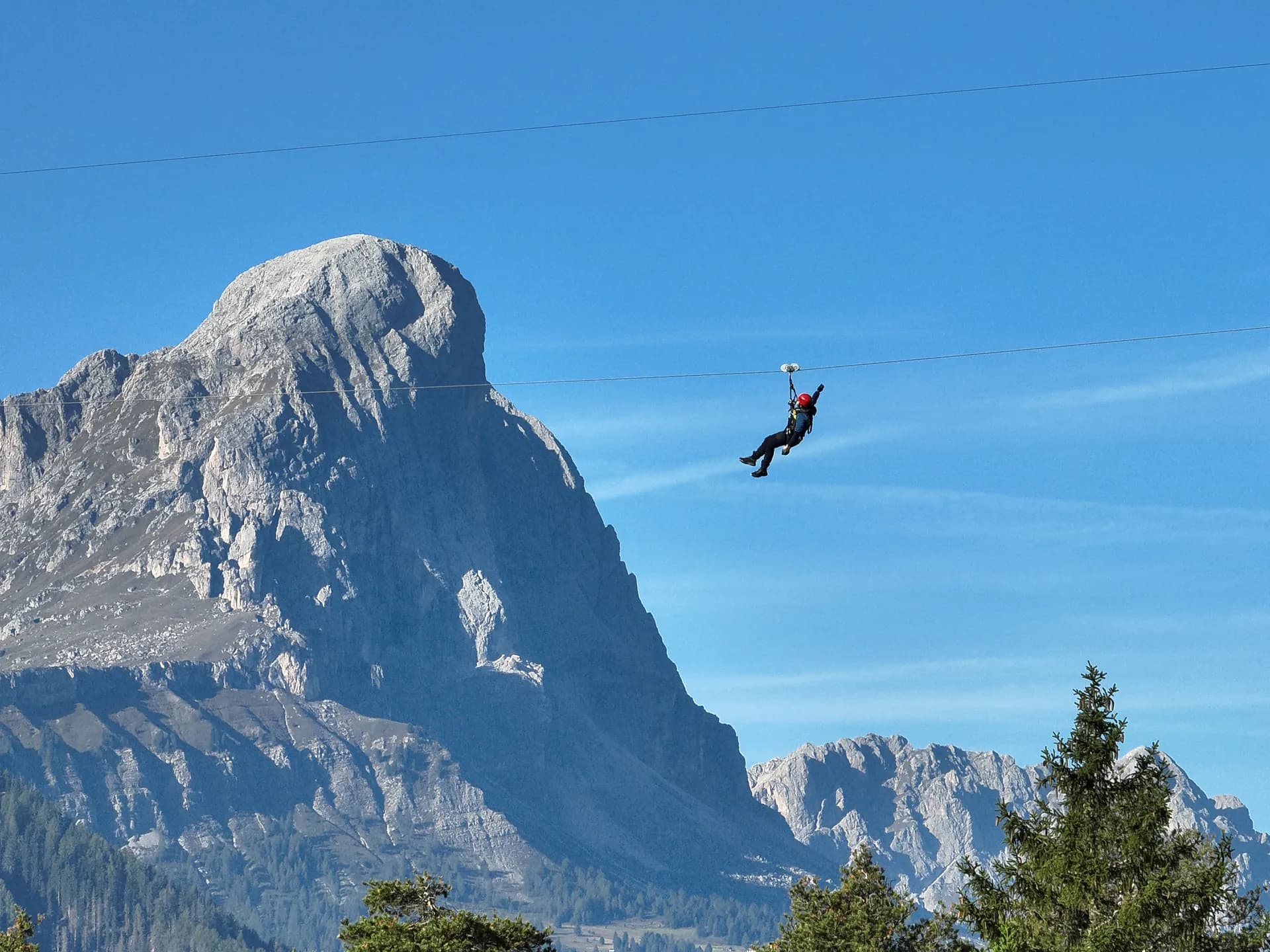
When you fly on the Dolomites zipline, the landscape you see beneath and around you is not just geological — it is mythological. The mountains you fly over are King Laurin's petrified roses. The forests you cross are home to the Salvanel. The streams you hear flowing are the dwelling of the Anguane. The Fanes plateau, visible in the distance, guards a sleeping kingdom.
Knowing the legends does not change the landscape, but it changes the way you see it. Every sunset becomes Laurin's garden catching fire. Every sound in the forest could be a Salvanel. Every reflection on the water could be an Anguana.
Ladin Culture: Guardian of the Stories
The legends of the Dolomites are the heritage of Ladin culture, the culture of the people who have inhabited these valleys for millennia. Ladin is a Romance language spoken by approximately 30,000 people in the Dolomite valleys, and the legends are a fundamental part of its identity.
The Dolomites are a UNESCO World Heritage Site not only for their geological beauty, but also for the cultural heritage they carry. The legends are part of that heritage — stories that give meaning to stone and snow.
Discover Our AdventuresCome and see the landscape of legends with your own eyes. Fly above King Laurin's garden. Walk through the Kingdom of Fanes. And let the stories of the Dolomites become yours too.
Contact Us for InformationRead Also
- Ladin Culture in the Dolomites — The history of the people who guard the legends.
- Dolomites UNESCO Heritage — Why these mountains are unique in the world.
- Fanes-Senes-Braies Nature Park — Hiking through the legendary kingdom.
